There’s a specific kind of dread that comes with lifting the lid of your washer and finding your clothes sitting there, soaked, in a puddle that should have drained away twenty minutes ago. Maybe you heard a weird humming noise before the cycle stalled. Maybe it just went quiet. Either way, a washer not draining is one of those problems that feels bigger than it usually is.
After years of fixing washers around Santa Barbara and Ventura County, we can tell you a washing machine not draining almost always comes down to one of a short list of causes. Most are simple. A few need a professional. This guide walks through both so you know where you stand before deciding what to do next.
Short version: water that won’t leave the tub is usually blocked somewhere: a clogged hose, a jammed pump, or gunk in a filter. Occasionally it’s electronic instead, like a washer error code flagging the drain sensor or a door that isn’t latching the way the machine expects.
1. The Drain Pump Is Clogged or Just Worn Out

The drain pump is the little motor doing the heavy lifting at the end of every cycle; it’s what actually pushes water out. Over years of use, a stray button, bobby pin, or wad of pet hair can jam it, or the pump simply reaches the end of its life. You’ll usually hear it before you see it: a persistent humming during what should be the drain cycle, with barely a trickle of water actually leaving. That’s a fairly clear sign of drain pump failure.
Many front-load machines have a small access panel near the bottom leading to the pump area, worth a look once unplugged (keep a towel nearby; there will be water). If the pump motor has burned out rather than just being clogged, that’s a technician’s job, since reaching it means partially disassembling the machine.
2. Something’s Blocking the Drain House
The hose running from the back of your washer to the wall or utility sink does quiet work you never think about until it stops working. A kink from the machine sitting too close to the wall, or years of lint slowly caking the inside, can choke the flow almost entirely.
This is most likely your clogged drain hose if draining has become significantly slower over time or if the hose feels bulky and rigid. Take the washer out (unplugged) and follow the path of the hose; sometimes it’s as simple as straightening it.
3. The Coin Trap or Filter Is Full
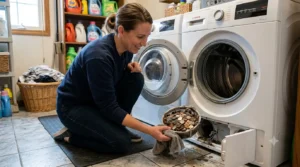
Almost every washer has a small filter built to catch the odds and ends that fall out of pockets before they reach the pump. It quietly does its job for months, right up until it’s full, at which point drainage slows to a crawl.
This one’s easy to spot in hindsight: the machine was fine, then suddenly wasn’t, sometimes with extra noise thrown in. Your owner’s manual will point you to the filter’s location (usually a small door near the bottom-front). Cleaning it is genuinely one of the safest, easiest fixes here.
4. The Blockage Isn’t Even in the Washer
Sometimes the washer is working fine, and the real problem is downstream, in the standpipe or utility sink drain it empties into. That drain can develop its own clog over the years, independent of anything happening inside your machine. It’s also worth knowing that in some kitchens and laundry rooms, that same drain line is shared with a dishwasher, so a backup there can show up as a washer problem too.
The giveaway: water appears to drain, then immediately backs up or pools near the drain point. Run water straight into the standpipe and watch how it behaves. Sluggish on its own? That’s a plumbing issue, which usually calls for snaking equipment most of us don’t keep around.
5. An Error Code Is Telling You Something
Modern machines, particularly those with front-load washer drain issues, detect inadequate drainage and halt the cycle instead of continuing aimlessly. You may see “dE” or “F02” on the display, depending on the brand. Whirlpool’s own troubleshooting page, for example, walks through exactly what that code means on their machines.
A quick power cycle, unplugging it, waiting a minute, and plugging it back in, can clear a one-off sensor glitch. If the same code returns on the next load, it’s not a fluke, and it’s worth having a technician trace it down before it becomes a bigger repair.
6. The Lid or Door Isn’t Registering as Closed

Drainage may not be the problem at all if your washer feels stuck mid-cycle, fills with water, and then stops without agitating or draining. A built-in safety feature may be triggered by a lid switch or door lock that isn’t detecting a secure closing.
A shifted load may prop the door open just enough to deceive the sensor, so make sure the door is truly latching all the way. Closing fine but still stuck? The switch has likely failed and needs replacing.
7. The Load Is Overloaded or Unbalanced
Stuff too many towels in at once, or let a comforter bunch on one side of the drum, and the balance sensors will often halt the whole cycle as a protective measure, draining included. You’ll usually hear this one coming, with loud banging right before everything goes quiet.
Redistribute the load, pull out an item if it’s packed too tight, and restart. A properly balanced load still refusing to drain rules this one out.
When It’s Time to Stop Troubleshooting
DIY checks handle a lot of drainage problems, but a few situations are worth handing off right away:
- You’ve cleared the filter and hose, and it’s still not draining
- The same washer error code keeps coming back
- There’s a burning smell, an unfamiliar noise, or standing water risking your floors
- The machine is still under warranty (DIY work can void it)
- Fixing it means opening electrical or motor components
Pushing past that point on your own can turn a simple fix into a much bigger one, or worse, a safety issue. The Consumer Product Safety Commission recommends unplugging any appliance that’s shown electrical trouble rather than continuing to use it. Don’t let it sit too long, either. Travelers Insurance lists washing machines among the most common sources of home water damage, so water not pumping out that gets ignored can mean more than a ruined load of laundry.
Why Choose Dk Appliance Repair For your Washer Repairing
DK Appliance Repair has been fixing washers, dryers, and just about everything else in Santa Barbara and Ventura County homes since 2006. Our technicians show up with the parts most drainage repairs need already in the truck, so a washer not draining call usually wraps up in one visit, with a flat, upfront price before anything gets touched.
Eyeing a replacement instead? Our washer repair specialist uses noticeably less water and energy than standard models, which is worth factoring in if repairs start creeping toward replacement cost.
Final Thoughts
A washer that won’t drain feels like a crisis in the moment, but it’s almost never a mystery once you work through the list. Start small: filter, hose, and load size. If none of that solves it, you’re probably dealing with a pump, a plumbing clog, or a sensor that genuinely needs a trained set of hands. Catching it early is what keeps a small fix from turning into a much bigger one.
Still stuck after going through all seven? Reach out to DK Appliance Repair and we’ll get someone out to take a look, or check our FAQ page if you’ve got other questions before booking.
FAQs
Why won’t my washing machine spin or drain?
Most of the time, the two go hand in hand; a blockage can appear exactly like a spin issue because most washers won’t spin until the tub is completely drained. The drain pipe and filter should come first.
Can I solve a washer drain issue on my own?
Occasionally. Most folks can reach a blocked filter or a kinked hose. It makes more sense to call someone when a worn-out pump or broken lid switch requires getting inside the machine.
How much does it cost to fix a washer that won’t drain?
Depending on the cause, yes. When labor and part costs are taken into account, changing a pump is more expensive than clearing a filter, which is essentially free. Before beginning any work, we always provide a flat, upfront quote.
Is a washer not draining an emergency?
Not often, but it’s also not something to put off for weeks. If standing water remains in the drum, it may eventually overflow and harm your flooring, develop mold, or begin to smell.
How can I determine whether my drain pump is malfunctioning?
The most obvious indicator, especially if the filter and hose are completely clear, is the humming or buzzing sound that occurs throughout the drain cycle combined with little to no water actually exiting the tub.
