There is nothing as frustrating as removing clothes from the dryer only to find they remain wet just like they were when it went in. You double-check the settings, restart the machine, and wait another 40 minutes, yet there is still no change. If your dryer is spinning, operating, and producing all the expected sounds but fails to generate any heat, you’re encountering one of the most typical frustrations that homeowners experience in the laundry room.
The positive aspect? A dryer that is not heating is usually linked to a few common issues, and most of them are straightforward to identify once you know what to check. In this guide, we will explore the reasons behind your dryer’s lack of heat, detail the troubleshooting process step by step, and highlight when it’s time to stop making assumptions and seek help from a professional. Whether you are handling an electric dryer that is not properly drying clothes or a gas model that’s emitting cold air, the diagnostic process is largely consistent, and by the conclusion of this article, you’ll have a clear plan of action to resolve the issue of your dryer not heating and effectively restore your laundry routine.
Why is My Dryer Running But Not Heating?
Before jumping into repairs, it helps to understand how a dryer truly operates. In basic terms, a clothes dryer draws in air, heats it with an electric heating element or a gas burner, pushes that hot air through the tumbling drum to evaporate moisture from your clothes, and then vents the warm, humid air release through a duct. When any single part of that chain breaks down, you end up with a dryer that spins normally but generates little or no heat.
Numerous factors can lead to a “no heat” problem because so many components cooperate. While others may need a technician with the right tools and spare parts. Some of them are easy to fix and affordable to repair. Let’s look at the most common issues.
2. A Failing Heating Element (Electric Dryers)
Let’s examine the heating element in electric dryers, consisting of a wire coil that produces heat when air passes over it. Over time, this part may eventually overheat, develop a fracture in the coil, or lead to a short circuit. When this happens, you have a typical dryer heating element issue: the drum rotates, the timer progresses, but the air expelled feels no warmer than room temperature.
Heating elements typically don’t break down unexpectedly. Frequently there is a noticeable decrease in drying performance before the element quits entirely, and clothes may need more cycles or longer to dry. If you suspect this is the issue, using a multimeter test can verify whether the element has continuity. Because this involves working around exposed electrical components, many homeowners opt to have a licensed technician handle the diagnosis and heating element replacement safely rather than risk injury or further appliance damage.
3. Gas Supply or Ignition Issues (Gas Dryers)
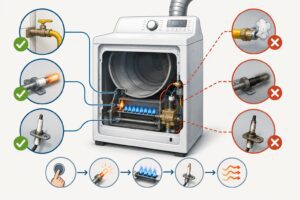
When a gas dryer fails to generate heat, the issue is usually related to certain components: the igniter, gas valve solenoids, or flame sensor. A weak or broken igniter won’t get hot enough to light the gas, while a faulty gas valve solenoid may prevent gas from flowing to the burner even if the igniter is working correctly. In some cases, the gas supply itself could be interrupted, which is worth checking before assuming a component failure.
Fixing a gas dryer requires careful handling of fuel connections, which needs to be treated carefully while repairing a gas dryer. If you detect a gas odor at any time, stop using the equipment immediately and contact a specialist for assistance.
4. Vent and Airflow Blockages
One of the most frequent causes for an electric dryer to fail in drying clothes efficiently is not a malfunctioning l; it’s a dryer vent blockage. Lint, debris, and even small animal nests can build up inside the exhaust duct over time, restricting the flow of hot air out of the dryer. When this happens, two issues commonly arise: Clothes take longer to dry, and the dryer’s built-in safety mechanism (like that thermal fuse we mentioned) may activate to prevent overheating, cutting off heat entirely.
As noted by Bob Vila , you should notice a consistent stream of warm air coming from the outdoor vent while the dryer operates, and if that airflow feels weak, the vent or lint screen is typically the cause. The risk extends beyond drying performance. If it is not handled. Cleaning the lint trap often before every load and getting your vent professionally cleaned at least once a year isn’t only beneficial for drying performance; it also promotes crucial home safety.
5. Faulty Thermostats, Timers, or Control Boards
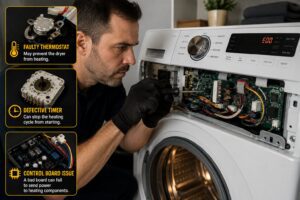
Today’s modern dryers use cycling thermostats and, in many newer models, electronic control panels to regulate the heat during operation. If a thermostat becomes stuck or a control board fails. The dryer might not activate the heating element or gas valve at all, even though everything else appears to be functioning. Diagnosing these issues on your own can be difficult, as the symptoms can overlap with several other problems on this list. This is the point where expert dryer troubleshooting really pays off; a technician may utilize diagnostic equipment to pinpoint the exact failed component rather than replacing parts by trial and error.
How to Troubleshoot a Dryer That Isn’t Heating
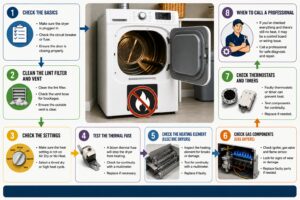
If your dryer is not warming up, here is a simple list of actions to take before reaching out for help:
- Check the lint trap and vent first: This is one of the cheapest and easiest fixes, and it frequently resolves a surprising number of heating issues by itself.
- Confirm the dryer is getting power: Verify that the electric dryers typically operate on a 240-volt circuit that is split between two breakers. If one of these breakers is tripped, the dryer may still spin but will not generate heat.
- Listen for the igniter (gas dryers): You should be able to detect a soft click followed by a gentle whoosh as the burner ignites. Lack of sound usually indicates an ignition issue.
- Look at drying time trends: A slow decrease suggests a possible airflow obstruction or a failing heating element; a sudden complete lack of heat typically points to a blown fuse or malfunctioning component.
- Avoid opening up the cabinet unless you’re comfortable with basic appliance repair: Working near heating elements, gas lines, and electrical parts can be very risky if you are not experienced with the procedure involved.
If the steps do not fix the problem, it is probable that a specific part has malfunctioned and will require replacement. At this point consulting a professional can save you both time and money while preventing you unnecessary trial and error. Technicians from DK Appliance Repair usually have the most commonly needed parts on hand and often manage to complete a dryer repair the same day they identify the problem, whether the issue lies with a fuse, heating element, or airflow blockage. If your washing machine is having issues as well, it’s advisable to have both appliances examined during the same appointment. Our washer repair services address problems such as leaks, drainage, and spin issues that often show up around the same time as dryer trouble in busy homes.
Should You Call a Professional for a Dryer Not Heating Up?
It’s completely normal that not every problem with a dryer can be resolved independently. You should think about contacting an expert if:
- You’ve cleaned the vent and lint filter yet the dryer is still not generating heat
- You notice a smell of gas near a gas-powered dryer
- You’re unsure or hesitant about testing electrical components with a multimeter
- The dryer keeps causing your circuit breaker to trip multiple times.
- You’ve changed a part by yourself, but the issue persists.
A skilled technician can efficiently identify the issue with the use of appropriate diagnostic tools, obtain the necessary replacement components, and restore your laundry routine without any uncertainty. If you’re located in Santa Barbara or Ventura County, DK Appliance Repair Services covers a wide range of appliances from dryers and washers to ovens and refrigerators, so any related appliance issues can often be resolved in a single visit. For common repair advice, visit our FAQ’s page or contact us directly to schedule a same-day service appointment.
Final Thoughts
A dryer that won’t heat isn’t something to just shrug off depending on the cause, you could be looking at a real safety issue, especially if there’s an electrical component overheating or a vent that’s badly blocked. The good news is that the list of likely culprits is pretty short: a blown thermal fuse, a bad heating element, an ignition problem if you’ve got a gas model, poor airflow, or a faulty control board. Run through the troubleshooting steps we covered above and you’ll usually land on the answer pretty quickly. Honestly, more often than not, it just comes down to a clogged vent clean it out and you’ll get your heat back and cut your drying time way down.
However, fixing appliances entails dealing with electricity, gas connections, and moving parts that are not always forgiving of trial and error. After the initial checks, if your dryer still leaves your clothes wet after basic checks, it’s wise to have a qualified technician take a proper look before the issue gets worse or turns into a bigger repair bill. A little brief of professional care might spare you a lot of frustration and a few additional loads of partially dried clothing in the future.
FAQ’s
- Why is my dryer running but not producing any heat?
A few usual suspects here: a tripped thermal fuse, a burnt-out heating element (if it’s electric), an ignition problem (if it’s gas), or a clogged vent that’s tripped a safety shutoff. The tricky part is that the drum still spins and the timer still runs, so at first glance everything looks normal — it’s easy to miss that the heat just isn’t there.
- Can I fix a dryer that’s not heating myself?
Some of it, sure. Clearing out lint from the trap and vent is easy and safe to do yourself. But once you’re getting into the heating element, thermal fuse, or gas valve, you’re dealing with electrical or gas components, and that’s where I’d call in a technician rather than risk it.
- How do I know if it’s the thermal fuse?
The telltale sign is a full cycle where the dryer tumbles as usual but never actually heats up. Grab a multimeter and test the fuse for continuity — if it doesn’t show continuity, it’s blown and needs to be swapped out. Don’t bother trying to reset it; these things are made to fail once and stay failed.
- Why does my electric dryer need two or three cycles to actually dry a load?
Nine times out of ten it’s airflow—a clogged vent or a dirty lint screen choking off the exhaust. It can also mean the heating element is on its way out, but before jumping to that conclusion, clean the vent out completely and see if that fixes it first.
- How often should I get my dryer vent cleaned to avoid heating problems?
Once a year is the general rule of thumb—that’s what most fire safety folks recommend for keeping things running efficiently and safe. If you’re doing big loads all the time or your duct run to the outside wall is on the longer side, you’ll probably want to bump that up to every six months or so.
